
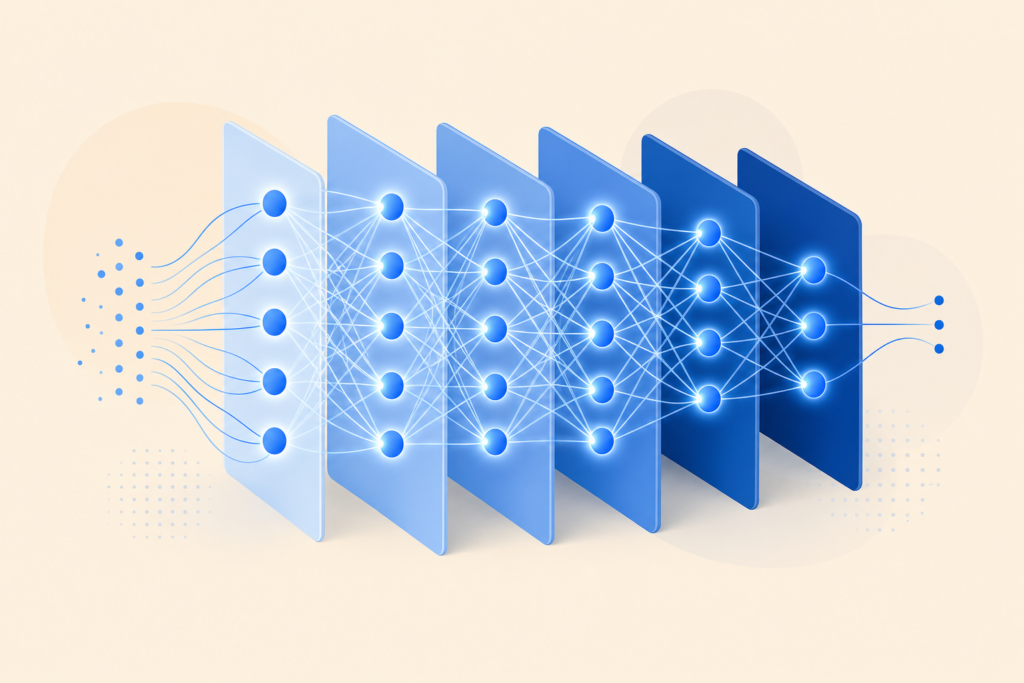
Deep learning uses neural networks with many layers to learn complex patterns — from pixels in photos to word relationships in text. It powers ChatGPT, modern image models, and voice assistants.
Hub: Complete Guide to AI for Beginners.
Why “deep”?
Each layer builds on the last:
- Layer 1: edges in an image
- Layer 2: shapes
- Layer 3: objects (cat, car, sign)
Depth lets the model learn hierarchies automatically.
What you need
| Resource | Why |
|---|---|
| Large datasets | More parameters need more examples |
| GPUs / cloud | Training is compute-heavy |
| Frameworks | PyTorch, TensorFlow, JAX |
Deep learning vs classical ML
Classical models (random forests, logistic regression) often win on small tabular business data. Deep learning dominates images, audio, and language.
Common architectures (names only)
- CNNs — vision
- RNNs / LSTMs — older sequence models
- Transformers — today’s default for language (How ChatGPT works)
Risks
- Overfitting (memorizing training data)
- Black-box decisions in regulated industries
- High energy use for large training runs
Next steps
Read Neural Networks: How AI Thinks and Computer vision basics.
Summary
Deep learning is multi-layer neural networks — the default approach for modern AI applications at scale.
Related on AIFree.vn
Practical checklist
- Write down one concrete task you will solve this week (not “learn AI” in general).
- Pick one primary tool and one backup — avoid subscription sprawl.
- Run a 20-minute pilot with real inputs; save prompts that worked.
- Add a human review step before anything customer-facing or legal.
- Schedule a 30-day review: keep, replace, or cancel the tool.
Common mistakes
- Chasing every new launch instead of finishing workflows.
- Trusting outputs for numbers, dates, or citations without verification.
- Uploading confidential data to tools your employer has not approved.
- Skipping internal links between related guides on your site or team wiki.
FAQ
How long until I see results?
Most readers save time within the first week if they apply one tutorial to a real task.
Do I need to code?
No for chat and image tools; yes for fine-tuning, RAG, or custom integrations.
What should I read next?
Use the Related on AIFree.vn section at the bottom of this article for hub pages and deeper tutorials.
Key takeaway
Treat AI as a draft accelerator with clear evaluation criteria — not an infallible expert. Combine tools with domain judgment and you will outperform teams that either avoid AI or use it without guardrails.
Study plan (7 days)
| Day | Focus | Output |
|---|---|---|
| 1 | Read this article + hub page | Summary notes |
| 2 | Try one tool with a real task | Saved prompt |
| 3 | Compare alternative tool | Short comparison table |
| 4 | Share draft with peer for review | Feedback bullets |
| 5 | Measure time saved vs baseline | 1 metric |
| 6 | Document team guidelines | 1-page SOP |
| 7 | Publish or ship internally | Completed artifact |
When to escalate to an expert
Escalate to a senior engineer, lawyer, or clinician when outputs affect money, safety, compliance, or customer contracts. AI assists research; humans remain accountable.
Glossary (quick)
| Term | Meaning |
|---|---|
| LLM | Large language model for text |
| RAG | Retrieval-augmented generation with your docs |
| Fine-tuning | Training a model on specialized data |
| Token | Chunk of text the model processes |
| Hallucination | Plausible but incorrect output |
AIFree.vn — practical AI & IT education. Last optimized: June 2026.